Authenticity
Our craftsmanship
Every Laguiole knife starts as a bar of steel and a block of wood and ends as a tool that fits one hand better than any other. Here's what happens in between.
Made to be held, not just looked at.
A Laguiole is not stamped out in one pass and boxed up. It passes through a dozen pairs of hands before it ever reaches a table, each one responsible for a single, unglamorous step:
grinding a bevel true, cutting a handle to the exact curve of a palm, setting a rivet so it never works loose. None of it is fast. All of it is the reason the knife still closes with a click after ten years.
The process, step by step
What actually happens between the forge and your table.

The blade
Each blade is cut, then ground and polished by hand until the edge is even along its full length. This is the step that decides whether a knife will actually cut, no amount of good handle-work can fix a blade that was rushed.

The handle
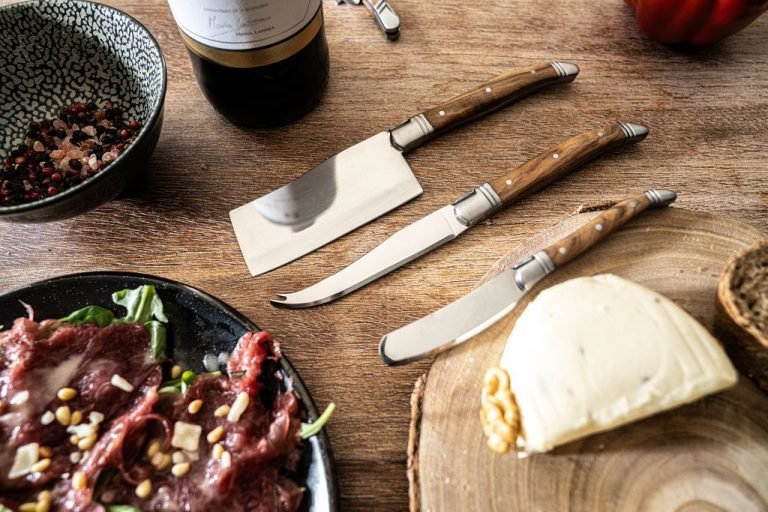
Handles are cut from natural material, which means the grain and colour of every single one is slightly different. No two handles are identical, and that’s treated as a feature, not an inconsistency to correct.

The bolster and rivets
The bolster is set and filed by hand until the blade sits flush against the handle with no gap. The rivets are set under pressure and finished flat, so nothing catches on your hand or snags a cloth.

The spring
On folding knives, the spring is tuned so the blade holds firm when open, closes with resistance rather than a loose flop, and doesn’t wear down after a few hundred uses.

Final inspection
Before a knife leaves the workshop, it is opened, closed, and run along the edge by hand. A knife that doesn’t meet the standard goes back to the bench, not into a box.
Why it’s done by hand
A machine can cut a blade shape in seconds. It can’t feel whether a bolster sits flush, or whether a spring has the right resistance, or whether a handle has been sanded past the point where the grain still shows. Those are judgment calls, and judgment calls are why this is still done by hand, slower, but with someone accountable for every knife that passes.